


Views: 0 Author: Site Editor Publish Time: 2026-02-06 Origin: Site


You're standing in front of two spools of PC wire (prestressed concrete wire), and they look almost identical. But one's got a smooth surface, the other has these little grooves running along it. Which one do you pick?
Here's the straight answer: indented PC wire grips concrete way better than plain PC wire, but that doesn't mean it's always the right choice. It depends on what you're building and how much you're willing to spend.
Let me break down the plain pc wire vs indented pc wire debate so you can make a smart decision for your project.
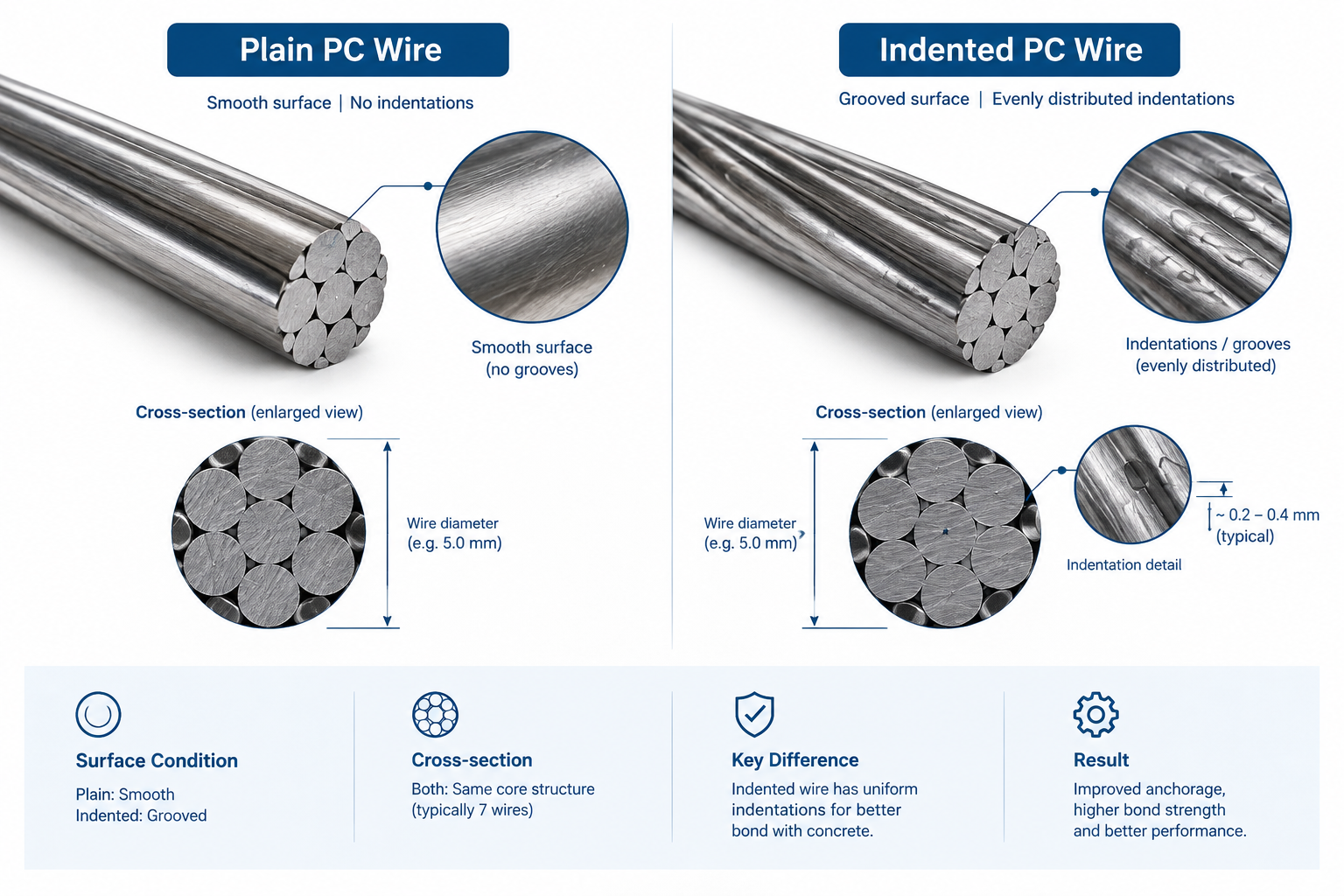
Let's start simple. The difference is literally skin-deep.
Plain PC Wire (also called smooth PC wire)
Completely smooth surface
Round cross-section
No surface markings or patterns
Looks like regular high-strength steel wire
Indented PC Wire (sometimes called grooved PC wire or patterned PC wire)
Mechanical indentations pressed into the surface
Grooves typically 0.3-0.5mm deep
Patterns run along the wire length
Creates a textured surface
Think of it like the difference between regular tires and snow tires. Both are round and roll, but one's got extra grip.
Here's where things get interesting. Those little indentations aren't just cosmetic. They completely change how the wire behaves inside concrete.
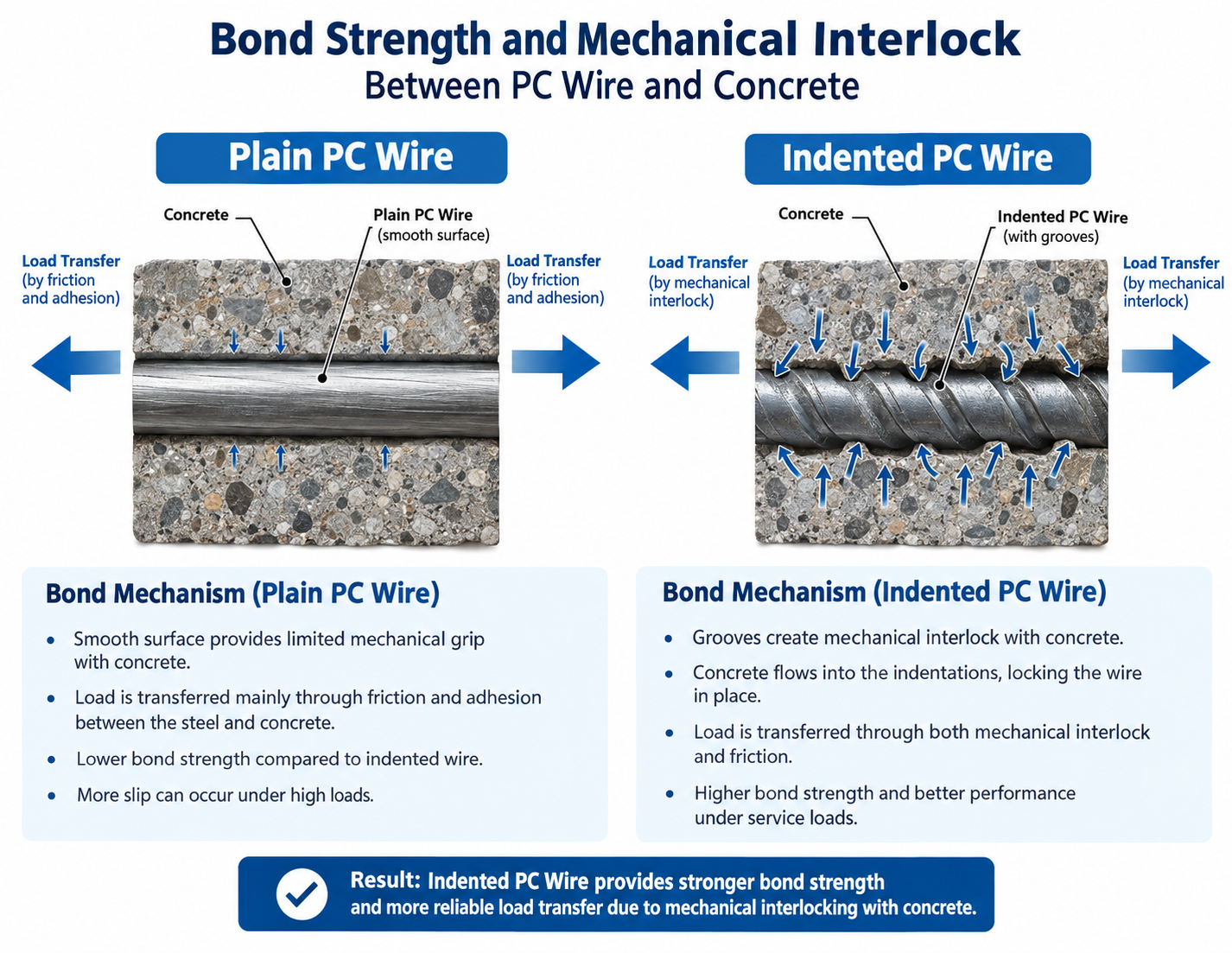
When you embed PC wire in concrete and tension it, the wire needs to transfer stress to the surrounding concrete. This transfer happens through bond.
Plain Wire Bond Mechanism
Relies mainly on friction
Chemical adhesion between steel and cement paste
Limited mechanical interlock
Indented Wire Bond Mechanism
Friction (same as plain)
Chemical adhesion (same as plain)
Plus mechanical interlock from the grooves
The grooves create little "teeth" that dig into the concrete. It's like the difference between trying to pull a smooth nail out of wood versus a threaded screw. Both hold, but one's way harder to pull out.
Bond Strength Comparison
Plain PC wire: 2.5-3.5 MPa bond stress
Indented PC wire: 4.5-6.0 MPa bond stress
That's roughly 60-80% better bond performance. For structural engineers, that's huge.
Wait, if indented wire performs better, why does anyone use plain PC wire? Good question.
Plain wire is cheaper to manufacture. No extra processing step to create the indentations. For price-sensitive projects where bond strength isn't critical, it's the economical choice.
Typical price difference: 10-15% less for plain wire
Plain PC wire works great for:
Railway Sleepers (Traditional Design) Some older sleeper designs spec plain wire because the transfer length isn't critical. The wire's embedded over a long enough distance that friction alone provides adequate bond.
Certain Precast Elements
Simple lintels with long embedment
Non-critical structural members
Elements where end anchorage provides most of the stress transfer
Low-Stress Applications If you're not pushing the wire to high stress levels, plain wire's lower bond capacity might be perfectly adequate.
Plain wire is easier to handle during production. No worries about damaging surface indentations during wire drawing or storage. Some manufacturers prefer it for that reason alone.
Most modern prestressed concrete applications lean toward indented PC wire. Here's why:
The bond strength of plain vs indented pc wire in concrete isn't even close. Indented wire transfers stress over a much shorter length.
This means:
Shorter development lengths required
Better performance in short-span members
Reduced cracking at member ends
More reliable stress transfer
ASTM A881 covers both types, but many specifications now call specifically for indented wire. It's becoming the industry default.
The standard requires:
Minimum indentation depth
Specific pattern configurations
Testing for bond performance
Quality control procedures
Indented wire is the go-to choice for:
Modern Railway Sleepers Current designs almost always specify indented wire. The improved bond allows for optimized sleeper geometry and reduced wire usage.
High-Performance Precast
Double-tee beams
Hollow-core slabs
Architectural precast panels
Parking structure components
Thin-Section Members When you've got limited concrete cover, you need maximum bond in minimum length. Indented wire delivers.
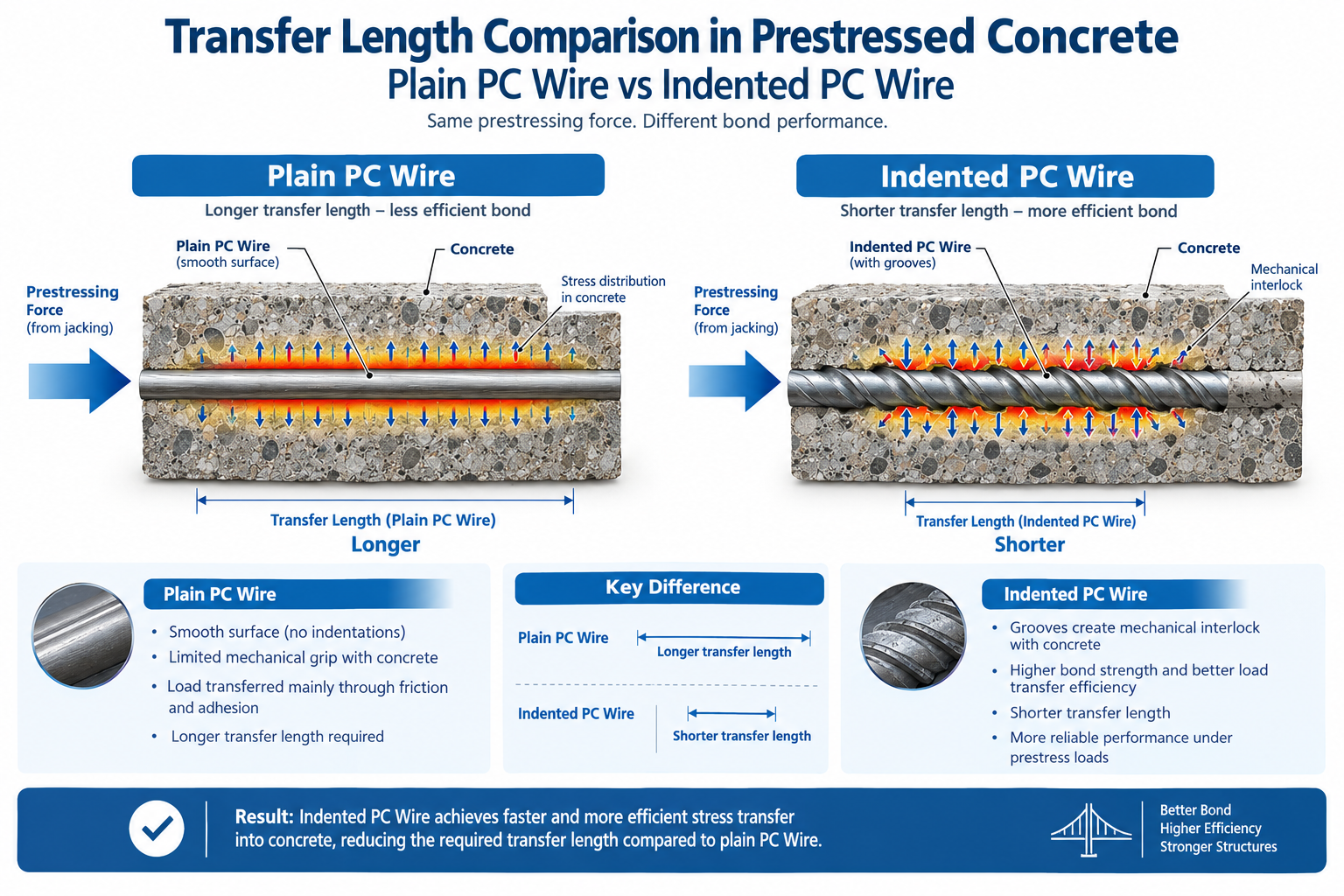
Let's get a bit technical (but I'll keep it simple). How does indentation improve bond strength in PC wire?
When concrete's poured and vibrated around indented wire, it flows into the grooves. Once cured, you've got concrete "keys" locked into the steel indentations.
Try pulling the wire out, and those keys have to either:
Shear off (requires lots of force)
Pull through the concrete (creates compression)
Crush the surrounding concrete
All three mechanisms provide resistance. Plain wire? It just slides if the friction is overcome.
Indentations create more uniform stress distribution along the wire length. Plain wire tends to have stress concentrations at the ends where slip begins.
Better stress distribution means:
Reduced risk of end-zone cracking
More predictable structural behavior
Higher reliability in service
This is where engineers get excited. Transfer length is how far the wire needs to be embedded before it reaches full effective stress.
Typical Transfer Lengths
Plain wire: 80-100 wire diameters
Indented wire: 50-65 wire diameters
For a 5mm wire, that's a difference of 150-175mm. In short members, that extra length might not even be available.
Both plain and indented varieties use the same base steel. The difference is purely the surface treatment.
Tensile Strength
Minimum: 1,570 MPa for both types
Typical: 1,650-1,750 MPa
Grade variations available
Elongation
Minimum: 3.5% at fracture
Both types perform similarly
Cold drawing process determines this property
Modulus of Elasticity
Approximately 200 GPa
No difference between plain and indented
Same steel composition for both:
Carbon: 0.75-0.85%
Manganese: 0.60-0.90%
Silicon: 0.15-0.30%
Sulfur: Max 0.040%
Phosphorus: Max 0.040%
The mechanical properties of cold drawn PC wire come from the drawing process itself, not the surface treatment applied afterward.
How do they make these two different products from the same raw steel?
Wire rod drawing through progressively smaller dies
Heat treatment (patenting) to achieve desired strength
Final drawing to exact diameter
Quality testing and spooling
Clean, straightforward process.
Same first three steps, then:
Indentation rolling or pressing
Pattern verification (depth and spacing checks)
Additional quality testing
Spooling
That extra step adds cost but creates the superior bond performance.
Let's talk money. The price difference between plain and indented prestressing wire is real, but is it worth it?
Plain PC Wire: $800-900 per ton (approximate) Indented PC Wire: $900-1,050 per ton (approximate)
You're looking at 10-15% more for indented. On a 10-ton order, that's an extra $1,000-1,500.
But wait, there's more to the story. Better bond performance can mean:
Reduced Wire Quantity Shorter development lengths might allow fewer wires in some designs. Savings: 5-10% less wire needed.
Design Optimization Engineers can push members harder with reliable bond performance. Thinner sections, lighter weights, lower shipping costs.
Reduced Risk Better performance means fewer field issues, less liability exposure, happier clients.
When you add it all up, the 10-15% premium often pays for itself.
Let me give you some real-world guidance on the plain vs indented PC wire comparison.
Modern practice heavily favors indented wire. The applications of indented PC wire in railway sleepers include:
Standard gauge sleepers
High-speed rail applications
Heavy haul configurations
Turnout sleepers
Use plain only if you're matching existing designs that specifically call for it.
Your structural engineer guide to selecting PC wire surface types depends on what you're making:
Use Indented Wire For
Hollow-core slabs (always)
Double-tees and single-tees
Beams with short end zones
Architectural panels
Parking structure components
Plain Wire Might Work For
Long-span simple beams with ample development length
Non-structural precast elements
Utility structures where cost is paramount
Honestly? If you're working at small scale, you'll probably only find indented wire available. It's what distributors stock because it's what everyone specifies.
How do you verify you've got what you ordered?
Plain Wire Check
Smooth, unmarked surface
Uniform diameter
No kinks or damage
Clean, rust-free appearance
Indented Wire Check
Clear, consistent indentation pattern
Proper groove depth (use depth gauge)
No damaged or flattened indentations
Pattern spacing matches specification
ASTM A881 requires:
Tensile testing (every production lot)
Bond testing for indented claims
Dimensional verification
Surface condition assessment
At TJ Wasungen, we test every batch to ensure PC wire standards are met. No exceptions.
Does the wire type affect how you handle it on site?
Plain Wire
Slightly more flexible
Easier to straighten if kinked
Less concern about surface damage
Indented Wire
Handle carefully to protect indentations
Avoid dragging over sharp edges
Don't use damaged sections (bond performance suffers)
Both types tension the same way. Standard PC wire prestressing procedures apply regardless of surface type.
Key points:
Clean wire before installation
Check anchors for damage
Monitor tensioning force carefully
Document actual stresses achieved
Let me clear up some confusion I hear all the time.
Myth #1: "Indented wire is stronger" Nope. Same base steel, same tensile strength. The indentations affect bond, not wire strength itself.
Myth #2: "Plain wire is old technology" Not really. It's still manufactured and specified for appropriate applications. Just less common than it used to be.
Myth #3: "You can't mix plain and indented in the same project" You can, but why would you? Stick with one type for consistency unless there's a specific engineering reason to mix.
Myth #4: "Indented wire costs twice as much" We covered this earlier. It's 10-15% more, not double.
Does surface type affect long-term performance?
Both types are equally susceptible to corrosion. The indentations don't create additional risk if properly embedded in quality concrete.
For aggressive environments, consider helical PC wire or protective coatings regardless of whether you choose plain or indented.
Indented wire maintains better bond over time. Research shows:
Less bond degradation from repeated loading
Better resistance to bond slip
More stable crack patterns under service loads
This matters for structures expected to last 50+ years.
Still not sure which type to use? Follow this decision tree:
Step 1: Check Your Specifications If your engineer specified one type, use it. Don't substitute without approval.
Step 2: Evaluate Bond Requirements Short development lengths available? Need indented. Plenty of embedment? Plain might work.
Step 3: Consider Your Budget The 10-15% cost difference a deal-breaker? Then evaluate if plain wire meets minimum performance requirements.
Step 4: Think Long-Term What's the expected service life? Critical infrastructure? Go with indented for peace of mind.
Step 5: Consult the Experts When in doubt, talk to your structural engineer or contact a reputable manufacturer for guidance.
Look, here's the truth: indented PC wire is the modern standard for good reasons. Better bond, shorter development, more reliable performance. For most prestressed concrete applications, it's worth the extra 10-15%.
Plain PC wire still has its place in specific applications where cost matters more than ultimate performance and where adequate bond can be achieved through longer embedment.
Your plain pc wire vs indented pc wire decision should be based on:
Engineering requirements (most important)
Available development length
Budget constraints
Long-term performance expectations
Industry standards and specifications
Don't just default to the cheapest option. Understand what you're getting and why it matters.
Need to specify the right wire for your project? We manufacture both plain and indented varieties to ASTM A881 standards. Every batch is tested, certified, and ready to perform exactly as specified.
Because at the end of the day, your structure's only as good as the materials holding it together.


